
Robin Hambleton originally published this article in Local Government Chronicle on 18/7/23
Giving a significant boost to local government tax raising power is the key to restoring trust in politics and bringing about sustainable economic growth, writes the emeritus professor of city leadership at the University of the West of England, Bristol.
Robin Hambleton, emeritus professor of city leadership, University of the West of England, Bristol.
Forty years ago, in the summer of 1983, local democracy in the UK started to tumble off a cliff.
In a startling move, the Conservative Government published a White Paper proposing that local citizens should no longer have the freedom to tax themselves as they wished.
Published on 1 August 1983, the Rates White Paper came as a profound shock to Conservative local government leaders, let alone politicians representing other political parties. The Government soon found itself struggling to persuade senior Tory local government leaders to tone down their angry opposition to the government’s direct attack on the central founding principle of local democracy.
The Conservative chairmen of the Association of District Councils (ADCs) and Association of County Councils (ACCs), remember this was in the days before the creation of the Local Government Association, were not deterred by the ‘behind the scenes’ pressures imposed on them by Tory ministers to fall into line.
Grave constitutional implications
They were very upset indeed. Ian McCallum, Conservative chairman of the ADC, said the Government’s plans ‘represent state intervention on a scale unprecedented in this country. They smack of Big Brother, on the threshold of 1984’. John Lovill, Tory chairman of the ACC said his association would be campaigning ‘hell for leather’ against the proposed bill.
These local leaders rightly drew attention to the grave constitutional implications of the Government’s desire to undermine the independent power of elected local governments in our country.
Sadly, the fervent objections of elected local government leaders from all parties were to no avail. Patrick Jenkin, the then Conservative Secretary of State for the Environment, and the originator of the totally misguided poll tax that ended the political career of Margaret Thatcher, ignored all of them.
The passing of the Rates Act 1984 meant that local electorates in England and Wales would no longer be able to vote for expenditure and rating policies of their own choice, an arrangement that immediately set UK local government apart from local authorities in other western democracies.
In the years since then the powers of local government have been eroded to the point where the evidence shows that the UK is now the most centralised country in Europe.
‘Devolution deception’
Endless ministerial announcements, in the period since 2010, about so-called ‘city deals’ and ‘devolution deals’, and the like, a national narrative that I have described elsewhere as a ‘devolution deception’, should not distract us from the extreme centralisation of power that is continuing to take place.
These behind closed door deals, and misleading claims about so-called ‘devolution’, cannot disguise the fact that right now, in the UK, around 80% of all spending decisions, and around 95% of all tax decisions, are made centrally rather than locally. This is entirely unacceptable in a country that claims to have a modern, responsive democracy.
With the public realm in a state of collapse across the country, with increasing levels of spatial inequality, and with very low levels of economic growth, it is time to reverse the super-centralisation of power within the UK state.
The first point to recognise is that the UK is now a strange outlier when compared with other advanced economies. Countries that have decided not to crush local democracy are outperforming the UK on just about every economic, social, and environmental indicator you can think of.
By way of example, I recently explained in these pages that in Sweden, a country in which elected local governments enjoy full constitutional protection from an overbearing central state, economic growth is much better than in the UK.
Moreover, Swedish environmental policies to address the climate crisis are far more advanced and, not surprisingly, the country has no need for food banks as UK levels of grinding inequality would never be tolerated.
Promising prospects
The good news is that solid evidence supporting the case for giving the fiscal power of elected local authorities a truly dramatic boost is mounting. The wide-ranging report by former PM, Gordon Brown, A New Britain: Renewing our democracy and rebuilding our economy, published in December 2022, sets out radical proposals for devolving new economic powers to elected local authorities.
Keir Starmer, in his New Year’s speech, picked up on themes Brown had presented and emphasised a ‘Take Back Control’ message stating: ‘We will spread control out of Westminster. Devolve new powers over employment support, transport, energy, climate change, housing, culture, childcare provision and how councils run their finances’.
While the speech did not set out any specific proposals relating to fiscal devolution, clearly a disappointment to many in local government, it offered promising prospects.
The need to rebalance local/central power relations is not going to go away, and it is encouraging to see that pro local democracy think tanks are now making a range of helpful contributions to the debate. For example, Jessica Studdert, in her April 2023 paper on Fiscal Devolution for New Local, outlines suggestions not just on how to strengthen local fiscal power, but also on how to deliver a solidarity system to ensure equalisation between areas to ensure no places are left behind.
At this important time in our national politics, it is worth remembering that opinion poll evidence consistently shows that councillors are trusted more that MPs and government ministers to make decisions about local services.
Local government leaders should not become absorbed in the minutiae of potential, so-called ‘devolution deals’, for their area. Rather they should keep their eyes on the main prize, which is to bring about a radical rebalancing of local/central power relations in Britain.
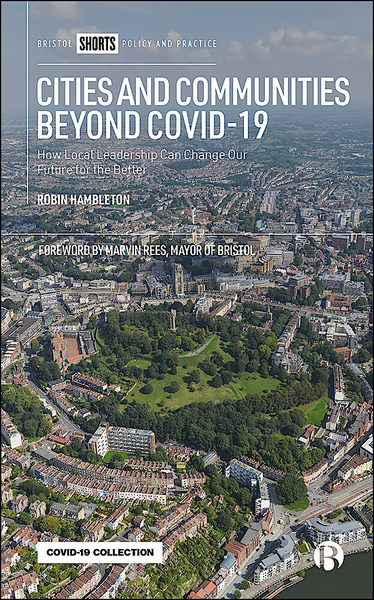
As I explain in my recent book on Cities and communities beyond COVID-19, it is now essential to bring about a major expansion of place-based power in the UK, hopefully to equate with the level of local power taken for granted in other western democracies.
Robin Hambleton, emeritus professor of city leadership, the University of the West of England, Bristol. His latest book, Cities and Communities Beyond Covid-19. How Local Leadership Can Change Our Future for the Better, was published in 2020.


 Bristol Civic Leadership Project